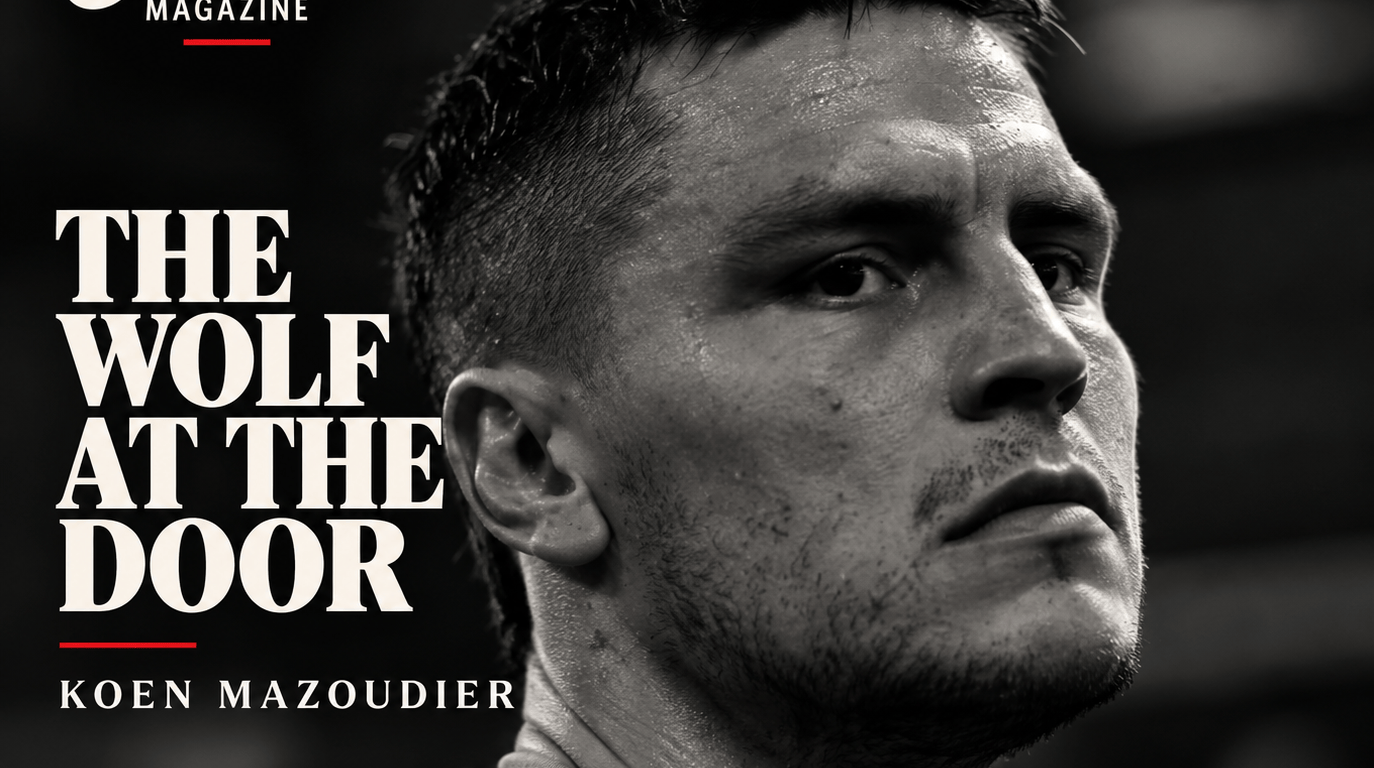
KOEN MAZOUDIER
An opponent disappears. Then another opportunity arrives. Hours before his latest fight changed, Koen Mazoudier spoke to CLINCH about disappointment, adaptation and the warrior spirit that keeps him moving.
CLINCH | IN CONVERSATION
By Finn Sloane
On Thursday morning, Koen Mazoudier already knew what it felt like to lose the biggest fight of his career.
CLINCH asked him to describe the moment Jermall Charlo disappeared from his immediate future the first time.
“Gut-wrenching.”
One word. No elaborate explanation required.
Hours later, reports emerged that Charlo had withdrawn again.
The timing changes the meaning of almost everything Mazoudier told us that morning.
Because much of our conversation wasn’t really about Charlo.
It was about adaptation.
THE FIGHT THAT WOULDN’T STAY PUT
The first opportunity had arrived earlier in the year.
Mazoudier was scheduled to meet former two-division world champion Jermall Charlo in Australia. The occasion represented a significant step forward for a fighter who had spent years working towards precisely that kind of international exposure.
Then Charlo encountered visa difficulties.
The fight disappeared.
Four weeks later, Mazoudier was back in the ring against Sam Beck, winning a ten-round majority decision.
And then Charlo returned to the conversation.
A different country. A different promotion. The same opponent.
When CLINCH suggested that the sequence must have felt like one extended training camp, Mazoudier’s answer was immediate.
“100%.”
There is a particular kind of exhaustion that comes from preparing for something that repeatedly changes shape.
Boxing demands physical readiness, but the uncertainty surrounding a major fight creates another challenge entirely.
The fighter must remain prepared for an opportunity that may arrive, disappear or return without warning.
Mazoudier had already experienced all three.
By Thursday afternoon, he would experience the second one again.
THE WILDCARD
CLINCH has previously described Mazoudier as a wildcard.
Not because his performances are unpredictable in the conventional sense, but because he possesses an ability to change the way he approaches an opponent.
Different rhythms. Different solutions. Different versions of the same fighter.
When we raised that description with him, the conversation moved towards adaptability.
It is an interesting quality in a sport built around preparation.
Training camps are designed to remove uncertainty. Opponents are studied, tendencies identified and responses rehearsed.
Yet the ability to adjust when the expected situation disappears can be just as important as executing the original plan.
Mazoudier understands that distinction.
His career has already required him to confront the difference between what he prepares for and what boxing actually delivers.
The defeat to Nikita Tszyu was another part of that education.
It was the biggest occasion of his career to that point, with a level of public attention he had not previously experienced.
The result was disappointing.
The experience was not wasted.
Mazoudier spoke about the importance of learning from those moments rather than allowing them to define everything that follows.
He is not the same fighter who entered that contest.
More importantly, he does not consider himself the same person.
FINDING THE QUIET
There is a contrast between the way Mazoudier fights and the way he speaks.
In the ring, he can be aggressive, physical and willing to exchange.
Away from it, his manner is measured.
He does not appear particularly interested in manufacturing intensity for an audience.
Instead, he spoke about the work involved in understanding himself.
He keeps journals.
He reads books concerned with personal development.
He makes time to sit with his thoughts.
These are not necessarily the habits people associate with the conventional image of a professional fighter.
But they are part of how Mazoudier approaches the demands of his profession.
The physical preparation is visible.
The psychological work generally isn’t.
And for a fighter who has spent much of the year dealing with uncertainty, that quieter discipline matters.
Family, friends and time in Umina on the Central Coast provide another kind of balance.
Boxing occupies an enormous part of his life.
It does not have to occupy every part of his identity.
That distinction becomes especially important when a career is moving between major opportunities and unexpected interruptions.
A fighter who attaches his entire sense of self to the next announcement risks having that identity shaken whenever the announcement changes.
Mazoudier’s approach appears to be different.
He wants the fight.
He prepares for the fight.
But he also understands that some of the circumstances surrounding it remain outside his control.
THE WOLF
The conversation eventually turns to dogs.
CLINCH happens to be speaking with Mazoudier while walking a dachshund, which leads to a discussion about the ancestry shared by domestic dogs — from the largest breeds to the sausage dog currently at the other end of the lead.
They all lead back to the wolf.
Mazoudier doesn’t hesitate.
“Yeah, I think my spirit animal is probably a wolf.”
It was an interesting observation, particularly given everything else he had said that morning.
Wolves are frequently used as symbols of aggression or dominance, particularly in sporting environments.
But that isn’t what makes the animal remarkable.
Its survival depends on intelligence, adaptability and an ability to respond to changing conditions.
It can hunt, travel, endure and adjust to its environment.
Strength matters.
So does judgment.
And adaptability had already become a recurring theme in Mazoudier’s career.
The fighter CLINCH had nicknamed “The Wildcard” because of his ability to change his approach inside the ring had spent much of the year doing precisely the same thing outside it.
An opponent disappears.
Another arrives.
The original opponent returns.
The location changes.
The preparation continues.
Mazoudier’s reference to the wolf also connected naturally with something else he spoke about during our conversation: the warrior spirit.
Not simply fighting, but the qualities he associates with people — and animals — built to endure difficult conditions.
Discipline.
Resourcefulness.
The willingness to continue.
In boxing, those qualities are tested in public.
Most of the time, they are developed somewhere considerably quieter.
For Mazoudier, that includes time in Umina on the Central Coast, family and friends, reading, writing in his journal and learning how to sit with his own thoughts.
And within hours of our conversation, the quality we’d spent much of the morning discussing was about to be tested again.
ANOTHER CHANGE
Several hours after our conversation, The Ring reported that Charlo had suffered an injury in training and would no longer face Mazoudier in Las Vegas.
It was the second time their proposed meeting had fallen apart.
The circumstances were different.
The result was familiar.
Once again, the Australian had prepared for one opponent and suddenly needed another.
This time, however, the date remained intact.
Mazoudier publicly confirmed that he still intended to fight on October 17.
Then the replacement became official.
PBC confirmed Armando Resendiz as Mazoudier’s new opponent.
Resendiz presents a markedly different challenge.
The Mexican defeated Caleb Plant by split decision in May 2025, a result that transformed his position within the division.
He subsequently lost the WBA title to Jaime Munguía in May this year.
He is younger than Charlo, active and accustomed to applying pressure.
For Mazoudier, the change is significant.
But it also creates another opportunity.
Rather than measuring himself against an established former champion returning from periods of inactivity, he will face a former champion whose recent performances have kept him directly involved in the division’s major contests.
The opponent has changed.
The significance of the occasion has not necessarily diminished.
And there is something particularly revealing about the timing.
On Thursday morning, Mazoudier spoke to CLINCH about adaptation.
By Thursday afternoon, boxing was demanding that he demonstrate it.
STILL AT THE DOOR
There is a temptation to treat every disruption in a fighter’s career as a dramatic turning point.
Sometimes it is simply the business.
Fights are proposed.
Arrangements change.
Opportunities disappear.
The work continues.
Mazoudier has already spent much of this year navigating that reality.
Charlo was supposed to be the opportunity.
Then he wasn’t.
Then he was again.
Now another opponent is waiting.
The opponent changed.
Again.
This time, Mazoudier did not have to wait four weeks for another fight.
PBC has confirmed Armando Resendiz will stand across from him in Las Vegas on October 17.
Hours before any of that was public, Mazoudier had spent part of his morning explaining to CLINCH why he identifies with a wolf.
Not because it sounds dangerous.
Because it adapts.
Jermall Charlo was the fight.
Then he wasn’t.
The date remains.
So does Koen Mazoudier.
The wolf is still at the door.

