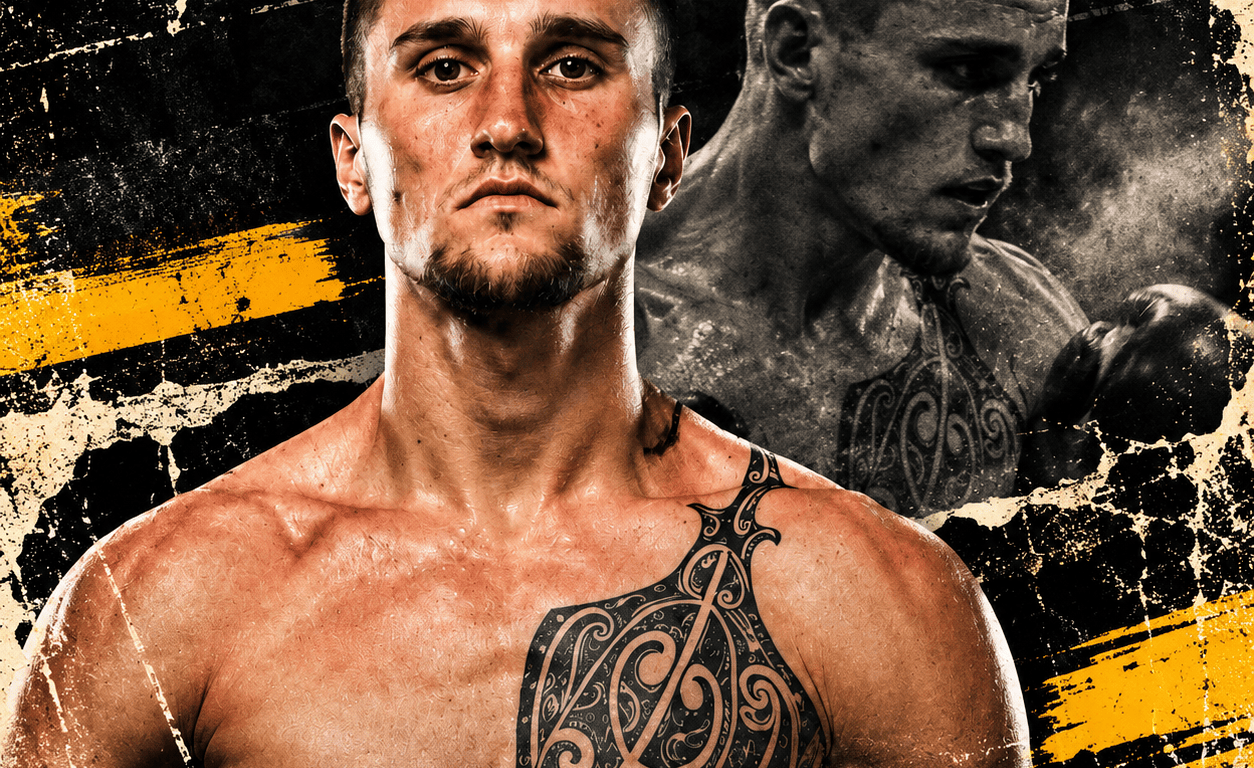
Dylan Biggs spent much of this year trying to get back into a boxing ring. On November 7, the WBC Australasia middleweight champion returns against Kudratillo Abdukakhorov — and inactivity is the last thing he wants.
There is nothing particularly complicated about Dylan Biggs’ relationship with boxing.
He trains.
He fights.
Then he wants to fight again.
Ask him what eight months without one felt like and the answer requires precisely one word.
“Terrible.”
For Biggs, that period wasn’t supposed to happen.
He and long-time coach Justin O’Leary say another fight had been agreed earlier in the year. A contract was signed. The opponent was a French fighter who held WBC Silver recognition. Everything, from their side, was ready to go.
Then the communication stopped.
Biggs has a theory about why. It remains exactly that — his theory.
What isn’t speculative is what it cost him.
Three or four months.
For some fighters, inactivity is simply part of boxing. For Biggs, it is almost an affront to how he believes the profession is supposed to work.
“Inactivity kills a lot of them,” he says.
O’Leary is even more direct.
“It’s his job. Everyone else goes to work every day.”
Now Biggs finally has another day at work approaching.
On Friday, November 7, he will defend the WBC Australasia middleweight title over ten rounds against Kudratillo Abdukakhorov.
And Biggs isn’t dismissive of the man waiting for him.
He describes Abdukakhorov as tough and strong.
That matters.
After spending so much time trying simply to get another fight, Biggs isn’t talking about November 7 as a date to fill or an opponent to move through. There is respect in the assessment — and an acknowledgement that getting active again doesn’t mean getting an easy night.
There is something fitting about that.
Biggs has spent the past two years discovering that his career works best when it keeps moving.
Now 19-1, he returned from his long absence in August and stopped the previously unbeaten Kenan Güzel in the ninth round, collecting the WBC Australasia middleweight title in the process. The result has since carried him to No. 8 in the WBC’s middleweight rankings.
It was another step in a run that began to transform his career in Saudi Arabia.
The 2025 WBC Boxing Grand Prix asked something unusual of its fighters: keep winning, keep recovering and keep coming back.
Biggs loved it.
Six fights sat between the beginning of the tournament and its conclusion.
By the third, he could see the finish line.
Two more fights.
Win this thing.
He did.
Biggs beat Hamza Azeem, Ciril Johnson Suffo and Petro Frolov before defeating Lancelot de la Chapelle in the semifinal and unbeaten Canadian Derek Pomerleau in the final.
A schedule that might exhaust another fighter suited him.
“We found it really easy,” O’Leary says.
Maybe that’s because O’Leary and Biggs have been doing this together for most of Biggs’ life.
O’Leary has coached him since he was around ten years old at Beaudesert Boxing Club.
Spend that long together and boxing convention almost demands some grand description of the relationship: mentor and student, father figure, Mr Miyagi.
Neither man is particularly interested.
“He’s got his job and I’ve got mine,” Biggs says.
“It’s not the movies.”
“It’s not Mr Miyagi.”
There is something revealing in how little mythology they require.
O’Leary coaches.
Biggs fights.
And if the opportunities don’t arrive often enough, O’Leary is prepared to find another way to keep him moving — even if that eventually means putting on shows around Toowoomba or Ipswich themselves.
“Just keep fighting.”
That philosophy also explains why Biggs has one eye on a much bigger Australian fight.
Chris Eubank Jr and Michael Zerafa are expected to meet. If something goes wrong and somebody needs a replacement, Biggs wants it known that he will be ready.
Give him five or ten days?
“Either Eubank or Zerafa.”
He doesn’t really consider that a call-out.
“It’s not even like calling someone out,” Biggs says. “I want the best fights.”
Zerafa represents exactly that kind of progression to him: an experienced Australian with international rounds behind him, and the sort of fight Biggs believes could provide a final domestic test before taking his career overseas.
But there is an important distinction.
That’s the fight Biggs can see further down the road.
Abdukakhorov is the fight actually in front of him.
And after a year in which opportunities have already disappeared once, Biggs knows better than most not to skip ahead.
It is difficult to separate that outlook from his broader view of boxing.
He wants progression to happen through fights.
Not through waiting.
That became particularly clear when CLINCH asked Biggs and O’Leary a deliberately simple question.
When someone tells a fighter that a fight is mandatory, what does that word mean?
“It has to be done,” O’Leary says.
Then he makes it even simpler.
“It means non-negotiable.”
Biggs reaches essentially the same definition.
“It means, like, it must be done, or guarantee, I guess.”
Neither answer requires a sanctioning-body rulebook.
Perhaps that’s the point.
Boxing has constructed an administrative vocabulary in which words that sound absolute can lead to situations considerably less absolute.
O’Leary has been around long enough to see the contradiction.
Ask what he would change about the sport and eventually everything comes back to the same thing.
“I wish people fight more often.”
His version isn’t revolutionary.
If you’re ranked number one, fight number two.
Reduce the number of competing claims.
Make rankings mean something.
Make the pathway visible.
Because, as O’Leary points out, boxing can produce a fighter ranked at the top without requiring that fighter to consistently face the people immediately around him.
Eventually his assessment becomes considerably less diplomatic.
“I just think it’s a shit sport, to be honest.”
He laughs.
He also keeps turning up.
So does Biggs.
That’s the contradiction sitting underneath much of professional boxing: the people inside it can recognise every absurdity and still organise their lives around getting back into a ring.
Biggs is rather less restless when he gets home.
Ask what he does away from boxing and the answer is perfect.
“Nothing. Sit at home.”
His partner, apparently, calls him the laziest athlete ever.
Then training starts again.
And Biggs goes back to work.
On November 7, that work has a name.
Kudratillo Abdukakhorov.
Ten rounds.
Biggs’ WBC Australasia middleweight title.
A fighter Biggs describes not as an inconvenience between himself and something bigger, but as tough and strong.
After spending so much of the year wanting nothing more complicated than another fight, perhaps that’s the best way to understand the one immediately in front of him.
Not as a stepping stone.
Not as something to keep him busy.
As work worth doing.
Because the Boxing Grand Prix winner, the WBC Australasia champion and now a top-ten WBC middleweight has made one thing particularly difficult to misunderstand.
Dylan Biggs wants to fight.
The sleeper has become the workhorse.

