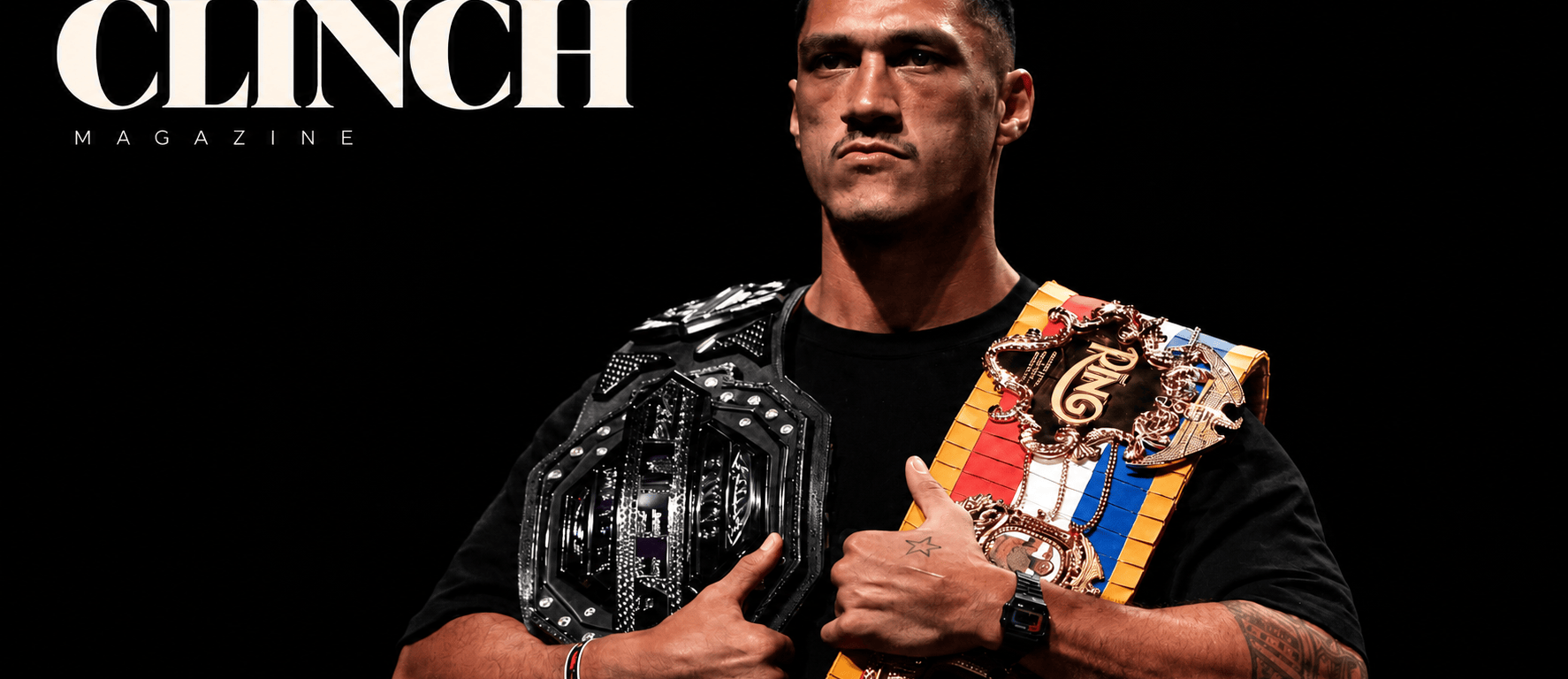
Jai Opetaia has a reported heavyweight opportunity with Deontay Wilder. He also has unfinished business with David Benavidez. The calendar says both can happen. Boxing makes the answer considerably more complicated.
CLINCH | THE AUDIT
By Finn Sloane
Yesterday, CLINCH asked a question.
Can Jai Opetaia do both?
At the time, the question was whether a reported heavyweight fight with Deontay Wilder could coexist with the Cinco de Mayo date Opetaia and David Benavidez had already discussed face-to-face.
Today, we can start answering it.
Mike Coppinger, speaking on Inside The Ring, reported that a heavyweight fight between Opetaia and former champion Deontay Wilder is being explored for the December 11 Tyson Fury–Anthony Joshua card.
The language matters.
“Nothing done yet,” Coppinger said, “but it is being explored and there are real talks.”
So this is not a fight announcement.
It is not a signed contract.
But it has moved beyond fantasy matchmaking.
And if it happens, Jai Opetaia could enter December as cruiserweight champion, fight one of the most destructive heavyweight punchers of his generation, and then attempt to return for another major assignment only five months later.
That assignment already has a name attached to it.
THE HANDSHAKE
The Opetaia–Benavidez conversation did not begin with Wilder.
After Opetaia stopped Noel Mikaelian in September, Benavidez entered the ring.
The two spoke face-to-face.
Opetaia wanted the fight.
Benavidez wanted the fight.
And Benavidez supplied the date.
Cinco de Mayo.
Nothing was signed. Nothing was formally announced. But unlike most speculative matchmaking, the interest wasn’t being relayed through promoters, managers or unnamed sources.
The fighters were standing in front of each other.
That matters.
It also makes what happened next considerably more interesting.
THEN BENAVIDEZ HEARD THE NEWS
During his appearance on Inside The Ring, Benavidez was told about the reported Wilder talks.
His response was immediate.
“No, that’s crazy, and that would be a shame because that’s a fight that we got to get made…”
Then the warning became clearer.
“If you guys saying that Jai Opetaia is already looking to fight Deontay Wilder, well then I’ll take my business elsewhere.”
Benavidez even supplied the alternative.
If Opetaia isn’t available for Cinco de Mayo, he said he would look toward Oleksandr Usyk.
That doesn’t mean an Usyk fight exists.
It does tell us something more useful.
Benavidez does not appear interested in waiting indefinitely for Opetaia.
And, as it turns out, the feeling is mutual.
“WE’RE NOT GOING TO SIT AROUND AND WAIT”
CLINCH contacted Tapu Opetaia on Saturday morning to ask where things currently stood from Jai’s side.
There was little he could disclose about the negotiations themselves.
But when asked about Benavidez’s suggestion that he would take his business elsewhere if Opetaia pursued Wilder, Tapu was considerably more direct.
“We’re not going to sit around and wait for him.”
Tapu gave CLINCH permission to publish the comment.
It doesn’t confirm Wilder.
It doesn’t cancel Benavidez.
And it certainly doesn’t create a signed fight in either direction.
What it does establish is the temperature on the other side of the conversation.
Benavidez says he has alternatives.
So does Opetaia.
Neither camp appears willing to construct its immediate future around waiting for the other.
That changes the question.
This is no longer simply about whether two dates fit on a calendar.
It’s about whether two independent careers remain aligned long enough for both dates to survive.
HOW WILDER BECAME AVAILABLE
The Wilder possibility did not appear in isolation.
Faz reported that discussions surrounding a potential Oleksandr Usyk–Deontay Wilder fight had collapsed roughly three weeks earlier, with requested purses exceeding the event budget.
That chronology is useful.
It is not causation.
There is no evidence that one negotiation collapsed specifically to create the other.
But Wilder becoming available provides context for why another major opportunity could suddenly enter Opetaia’s orbit.
And this isn’t simply another cruiserweight opponent.
It is a heavyweight opportunity involving a former world champion whose name carries commercial weight well beyond the division Opetaia currently rules.
THE HEAVYWEIGHT TEMPTATION
For Opetaia, Wilder offers something Benavidez cannot.
A heavyweight test.
Opetaia has already established himself at cruiserweight. The appeal of moving upward — even temporarily — is obvious.
But so is the risk.
Wilder remains one of boxing’s most recognisable heavyweight punchers. Even at this stage of his career, the physical proposition is fundamentally different from anything Opetaia encounters at cruiserweight.
And the consequences aren’t limited to December 11.
Because if Cinco de Mayo remains the ambition, Opetaia would need to go up to heavyweight, prepare for Wilder, fight him, recover, bring his body back down and prepare for Benavidez in approximately five months.
Technically possible?
Yes.
Simple?
Not remotely.
UP. AND THEN DOWN.
Timothy Bradley’s concern on Inside The Ring was not difficult to understand.
Going to heavyweight is one decision.
Coming back down shortly afterwards is another.
Weight isn’t simply a number entered on a commission form. Moving divisions changes preparation, nutrition, strength work and the physical demands placed on a fighter.
And Wilder introduces another variable.
We don’t know what Opetaia looks like after fighting him.
A clean win and an uncomplicated recovery produce one timeline.
A difficult heavyweight fight produces another.
A postponement, injury or contractual complication changes it again.
Five months can be plenty of time.
Until it isn’t.
THE OTHER MAN HAS A CALENDAR TOO
This is where Benavidez matters.
Opetaia does not control both sides of the proposed May fight.
Benavidez has his own career, his own opportunities and his own negotiating leverage.
And his comments make clear that he sees Cinco de Mayo as an opportunity rather than an indefinite reservation.
Now we know the Opetaia camp isn’t treating Benavidez as something requiring them to wait either.
That creates an unusual dynamic.
Both sides publicly want the fight.
Both sides have alternatives.
And both sides appear prepared to use them.
That’s often where boxing’s apparently straightforward plans become complicated.
Not because the fighters don’t want the same thing.
Because they want other things too.
SO, CAN HE DO BOTH?
On the calendar?
Absolutely.
December 11 to Cinco de Mayo leaves roughly five months.
Coppinger himself still believes there is a strong chance we see Opetaia–Benavidez in May.
Nothing about the Wilder discussion automatically eliminates that possibility.
But the question was never really whether two dates could fit inside five months.
The question is what has to happen between them.
Wilder–Opetaia first has to become a fight.
Opetaia has to move to heavyweight.
He has to come through it.
He has to recover.
He has to be prepared to return.
Benavidez has to remain available.
And, perhaps most importantly after the comments from both sides, neither man can decide that the opportunity immediately in front of him is more valuable than waiting for the other.
Five months looks like plenty of time when written on a calendar.
Two fights can fit there.
Whether both survive long enough to reach the ring is another question entirely.
Can Jai Opetaia do both?
For now, the answer remains the same one boxing gives almost every ambitious plan.
He has enough time.
Now he needs everything else to cooperate.

