Jaime Munguía has been announced for a world-title defence against Nikita Zon. The WBA says it never approved the fight. Its mandatory challenger is still waiting.
CLINCH | THE AUDIT
By Finn Sloane | 9 October 2026
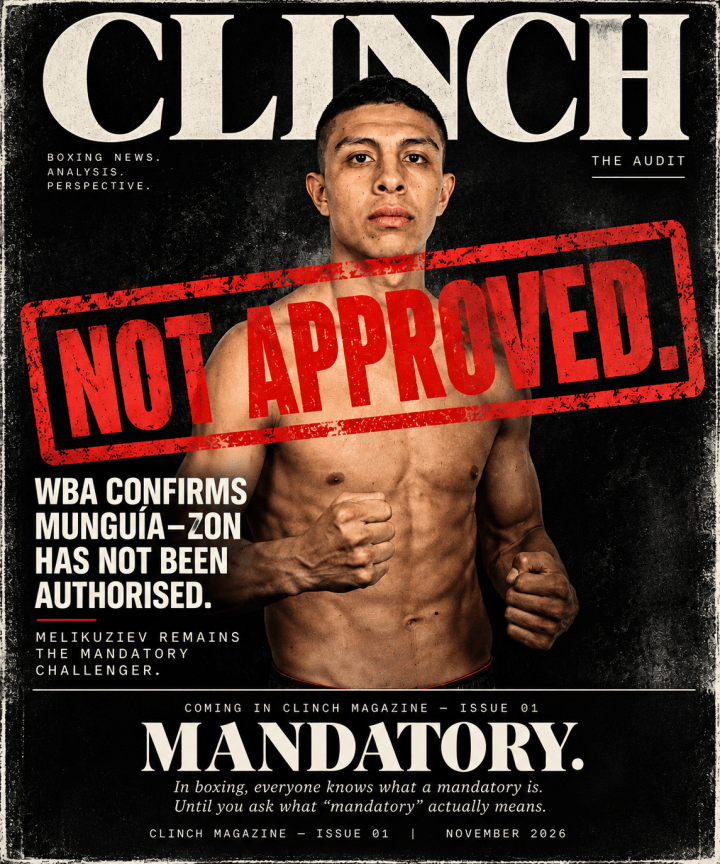
On September 21, the World Boxing Association ordered Jaime Munguía to defend his super-middleweight championship against Bektemir Melikuziev.
On October 8, Munguía was announced for a different fight.
On October 9, the WBA publicly confirmed something extraordinary.
It had not approved it.
In a statement published through its official X account, the sanctioning body said:
“The WBA has not approved the Jaime Munguia vs. Nikita Zon bout. Bektemir Melikuziev is the official contender in the super middleweight division.”
It added:
“The WBA will review the situation.”
Three sentences.
And a significant question about how a world-championship contest reached the announcement stage without approval from the organisation whose title was supposed to be defended.
THE ORDER
The paperwork begins on September 21.
That day, the WBA Championship Committee formally ordered Munguía to defend his world championship against Melikuziev.
The organisation’s published resolution was explicit.
Both parties were given 30 days to negotiate, with the period running through October 21.
Munguía had won the championship on May 2, defeating Armando Reséndiz by unanimous decision in Las Vegas.
According to the WBA, his 120-day mandatory-defence period expired on August 30.
The organisation consequently required him to face Melikuziev, its officially designated mandatory challenger.
It cited Rule C.10 of its championship regulations.
It also referred to Rule C.12, concerning restrictions on a champion facing another opponent within the relevant mandatory-defence period.
The resolution identified a possible next step.
If the parties could not reach an agreement, or either refused to negotiate, the Championship Committee could order a purse bid.
The language was not ambiguous about the intended opponent.
Munguía was ordered to fight Melikuziev. WBABoing
THE ANNOUNCEMENT
Seventeen days later, a different opponent appeared.
On October 8, the undercard for Canelo Álvarez against Christian Mbilli was announced.
The event is scheduled for October 31 in Riyadh, Saudi Arabia.
Among its advertised championship contests was Munguía defending the WBA super-middleweight title against Russia’s Nikita Zon.
Zon is unbeaten, with a professional record of 12 wins and one draw.
He also holds a position in the WBA rankings.
But he is not the organisation’s mandatory challenger.
That designation belongs to Melikuziev.
The announcement therefore created an immediate question.
Had the WBA authorised an alternative defence?
Had the mandatory challenger agreed to step aside?
Or had the September 21 order been modified?
The public announcement did not establish an answer.
And the WBA’s subsequent statement would make the situation considerably more complicated. Yahoo Sports
THE FIGHTER WAITING
Before the WBA publicly addressed the situation, Melikuziev had already done so himself.
In a statement published on Instagram, the Uzbek contender described the concessions he says his team made in attempting to secure the championship opportunity.
He claimed he had agreed to fight Munguía on short notice.
He said he had accepted the possibility of competing without the VADA testing his team ordinarily insisted upon.
He also claimed he was prepared to accept an exceptionally small purse, or even no purse at all.
These are Melikuziev’s allegations about the negotiations.
They are not independently established terms of an agreement.
But they reveal the extent of the contender’s public frustration.
Melikuziev said his team had informed him Munguía was still refusing the fight.
He then directed two questions towards the sanctioning body.
Why had a purse bid not been ordered?
And if the champion would not fulfil his mandatory obligation, why had he not been stripped?
Those questions go beyond the negotiations themselves.
They concern what the mandatory designation actually provides.
A fighter can be recognised as the official challenger.
A champion can be ordered to face him.
A negotiation deadline can be published.
But none of those steps, by itself, guarantees that the contest will take place.
Melikuziev is discovering the distance between possessing a mandatory designation and receiving a world-title fight.
THE REGULATOR RESPONDS
On October 9, the WBA entered the public conversation.
Its statement resolved one important uncertainty.
Munguía–Zon had not been approved by the sanctioning body.
It also reaffirmed Melikuziev’s position as the official contender.
That matters because the October 31 contest had been presented as a defence of the WBA championship.
The organisation responsible for administering that championship was now publicly saying it had not authorised the proposed matchup.
But the statement did not resolve everything.
The WBA did not announce that Munguía had been stripped.
It did not announce a purse bid.
It did not declare the October 31 contest cancelled.
And it did not explain what consequences, if any, would follow from the unapproved announcement.
Instead, it said the situation would be reviewed.
That is a meaningful distinction.
Not approved describes the fight’s regulatory status.
Under review describes what happens next.
Neither phrase should be mistaken for a final disciplinary decision.
WHAT HAPPENS TO THE DEADLINE?
The original negotiation period remains central to this dispute.
The September 21 order gave the parties until October 21 to reach an agreement.
The proposed Munguía–Zon fight is scheduled for October 31.
Just ten days separate those dates.
The WBA has now confirmed that it has not approved the alternative contest.
But its public statement does not establish whether the original negotiation timetable will be extended, whether a purse bid will be called, or whether another regulatory decision will intervene.
Those are separate questions.
And they matter.
A mandatory challenger does not automatically receive a purse bid simply because negotiations become difficult.
The WBA’s published order describes a purse bid as an available action for its Championship Committee.
It does not establish that one has already been ordered.
Nor does the public record currently establish that Munguía has formally refused a binding instruction in circumstances requiring an automatic sanction.
Melikuziev has made that accusation.
The WBA has not publicly reached that conclusion.
The distinction is essential.
The evidence supports a clear regulatory conflict.
It does not yet support a claim that a particular punishment is inevitable.
CLINCH ASKED
On October 9, CLINCH contacted the WBA seeking clarification on three specific matters.
First, whether an alternative title defence had been authorised through a special permit or another formal decision.
Second, whether Melikuziev retained his mandatory designation and whether the October 21 negotiation deadline had been modified.
Third, whether the September 21 order remained operative and under what circumstances the Championship Committee would proceed to a purse bid.
The WBA’s subsequent public statement addresses the first question directly.
It also reaffirms Melikuziev’s status.
The remaining procedural questions are not resolved by that statement.
CLINCH has not established whether its enquiry contributed to the timing of the public response.
What matters is that the organisation’s position is now on the record.
The fight was not approved.
WHAT DOES MANDATORY MEAN?
This dispute reaches beyond Jaime Munguía and Bektemir Melikuziev.
It concerns one of boxing’s most familiar expressions.
Mandatory challenger.
The designation sounds definitive.
It suggests an obligation.
A champion must defend against a particular opponent.
The contender has earned the position.
The sanctioning body has recognised it.
But the administrative process between designation and actual competition can involve negotiations, exceptions, deadlines, purse bids and further committee decisions.
The result is a system in which a fighter can possess an official mandatory position without possessing a confirmed fight.
Melikuziev remains the WBA’s recognised challenger.
Munguía remains its champion.
And a different championship contest has been publicly announced without the WBA’s approval.
Those three facts now exist simultaneously.
The WBA has acknowledged the conflict.
What it has not yet provided is the resolution.
THE NEXT DECISION
There is still time for the situation to change.
The October 21 negotiation deadline has not passed.
The October 31 event remains scheduled.
And the WBA has said it will review the matter.
A revised agreement could emerge.
A regulatory decision could alter the championship picture.
A purse bid could be ordered.
Or the proposed Munguía–Zon contest could be changed.
None of those outcomes has been established by the statement currently available.
For now, the record is unusually clear.
On September 21, the WBA ordered Munguía to face Melikuziev.
On October 8, Munguía was announced to face Zon.
On October 9, the WBA said it had not approved that fight.
The champion has an announced opponent.
The mandatory challenger has an official designation.
The sanctioning body has an unresolved decision.
And until that decision arrives, one question remains.
What, exactly, does mandatory guarantee?
COMING IN CLINCH MAGAZINE — ISSUE 01
MANDATORY.
In boxing, everyone knows what a mandatory is. Until you ask what “mandatory” actually means.
In November, CLINCH MAGAZINE releases its first issue.
Its feature essay, MANDATORY, examines what happens between a fighter earning that designation and actually receiving the opportunity it appears to promise — through the rules, the paperwork and the fighters living inside the system.
The Munguía–Melikuziev dispute is one of the cases CLINCH is following as part of that investigation.
CLINCH MAGAZINE — ISSUE 01 | NOVEMBER 2026

