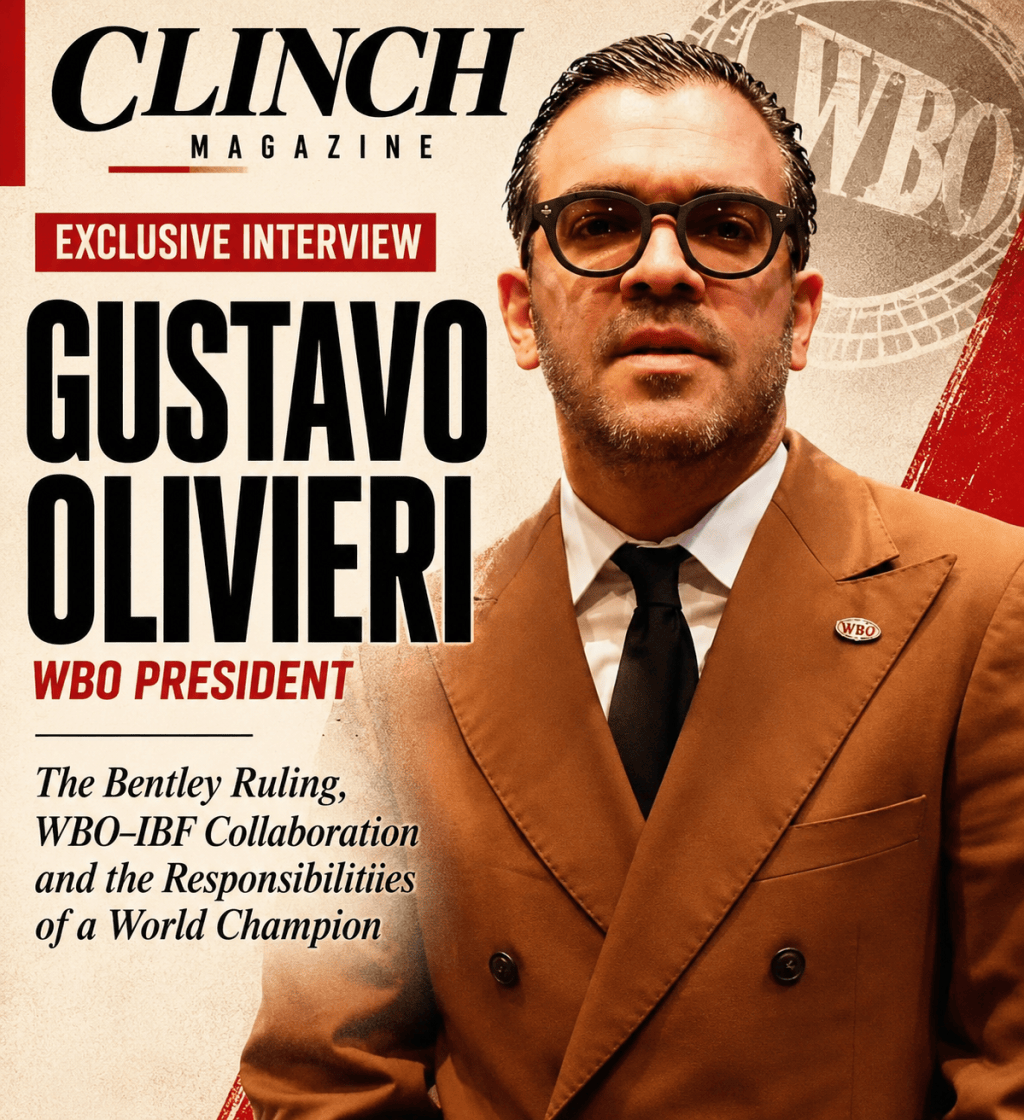
From a young Puerto Rican lawyer searching for an opportunity to the presidency of the World Boxing Organization, Gustavo Olivieri has learned that authority comes with responsibility. In an exclusive interview with CLINCH Magazine, he discusses the Denzel Bentley ruling, a historic collaboration with the IBF, and what boxing must do better for its fighters.
By Finn Sloane | CLINCH Magazine
Before Gustavo Olivieri became president of the World Boxing Organization, he was a young lawyer trying to find his own place in the world.
Born in Ponce and raised in Mayagüez, Puerto Rico, Olivieri came from a working-class family. His mother was a nurse, and his father operated a lottery-ticket business.
His introduction to professional boxing did not come through a championship career or a powerful promotional connection. It came through an education, an interest in sport, and the determination to find somebody willing to give him an opportunity.
After studying law at the University of Puerto Rico, Olivieri pursued postgraduate studies in sports law at Georgetown University.
He had practised law alongside his older brother, Gabriel, but wanted to establish a professional identity of his own.
In an earlier conversation with Un Round Más, Olivieri recalled the difficulty of finding an internship in professional sport. He approached organisations and pursued opportunities, often without success.
Eventually, he found his way to the WBO.
There he met Francisco “Paco” Valcárcel, the organisation’s longtime president.
The relationship would change his life.
Almost a decade of learning alongside Valcárcel eventually led Olivieri to the presidency in October 2024. And when CLINCH Magazine asks him which experiences prepared him for that responsibility, he does not begin by describing his own accomplishments.
He begins with the man who taught him.
“Former WBO President Paco Valcárcel, Esq., literally taught me every aspect of the business from the WBO regulatory standpoint,” Olivieri tells CLINCH.
Valcárcel introduced him to the industry’s key figures, brought him into meetings and discussions, and allowed him to observe the reasoning behind decisions that would affect fighters’ careers.
“The almost 10 years under Paco I was literally shadowing his day-to-day operations, decision-making process, the rationale and analysis of his decision-making process.”
Valcárcel remains a senior adviser to the WBO and, Olivieri says, continues to be his principal adviser.
For a man now responsible for making some of boxing’s most consequential administrative decisions, that apprenticeship remains central to his understanding of the job.
He also recognises that the education is never finished.
THE BUSINESS OF BEING FAIR
Professional boxing exists in a difficult relationship between sporting achievement and commercial opportunity.
The fighter who has earned the right to challenge for a championship is not always the fighter capable of generating the greatest financial return.
Sanctioning bodies are expected to recognise sporting merit while operating within an industry driven by promoters, broadcasters, investors and competing commercial interests.
Olivieri does not pretend those interests can be separated entirely.
“The sporting merits of a WBO Participant are paramount however the commercial aspect as well is important,” he explains.
He believes both considerations should be examined together and independently.
A deserving mandatory challenger, he suggests, should be selected in a manner that benefits the sport’s stakeholders without losing sight of sporting entitlement.
That principle becomes particularly important when a champion wishes to pursue a commercially attractive contest while another fighter holds a regulatory right to challenge.
And it brings the conversation to Denzel Bentley.
THE OBLIGATION REMAINS
Bentley’s removal as WBO middleweight champion has brought renewed attention to the organisation’s mandatory championship rules.
The British fighter won the WBO interim middleweight championship against Endry Saavedra before subsequently being elevated to full champion.
But the elevation did not remove an existing obligation to mandatory challenger Yoenli Hernández.
That distinction sits at the centre of the WBO’s ruling.
“When a WBO Participant engages in a sanctioned WBO bout,” Olivieri explains, the fighter is bound by the terms and conditions contained in the sanction approval letter.
Those conditions, he says, establish the contractual relationship between the participant and the organisation.
In Bentley’s case, the conditions attached to his interim championship contest against Saavedra were fundamental.
“Conversely, the mandatory obligation concept follows the division and not a particular Champion.”
Olivieri is explicit about the effect of elevation.
“The mere elevation from Interim to Full Champion does not override, cancel, terminate or modify the mandatory challenger obligation.”
According to the president, Bentley inherited the outstanding obligation when he accepted the conditions under which he fought Saavedra.
The dispute subsequently progressed through the WBO’s regulatory procedures.
Bentley’s appeal was rejected, and he failed to satisfy the organisation’s subsequent compliance requirements. On October 30, the WBO removed his recognition as middleweight champion.
The title was left vacant. Hernández was not automatically elevated.
CLINCH asked Olivieri whether a regulatory pathway had existed for Bentley to face Shane Mosley Jr while preserving Hernández’s mandatory rights.
Rather than offer a hypothetical interpretation, he referred us to the organisation’s published resolutions.
His explanation of the procedural history was nevertheless unequivocal.
“The record clearly establishes that Mr. Bentley was afforded multiple opportunities to comply, received proper notice, and was provided full due process, including the opportunity to challenge the Championships Committee’s determinations through the WBO’s established grievance procedures.”
Olivieri maintains that Bentley failed to comply with the Grievance Committee’s final award and the subsequent orders and directives issued by the Championships Committee.
“The WBO’s determinations were based on the applicable regulations, the established factual record, and the obligation to preserve the integrity of the mandatory championship system.”
The regulatory record reflects an important distinction: challenging a decision through an established appeals process is not the same thing as complying with the final determination once that process has concluded.
For Olivieri, the question extends beyond the circumstances of a single fighter.
If a mandatory obligation could disappear whenever an interim champion became a full champion, the entitlement of the waiting challenger would become uncertain.
His position is that the obligation remains attached to the division.
A new champion does not begin with a clean regulatory slate simply because his title has changed.
THE RIGHT TO QUESTION AUTHORITY
The Bentley case raises another important issue: how a sanctioning body explains its decisions to the fighters whose careers may be altered by them.
A ruling can affect championship recognition, earning opportunities and years of professional preparation.
CLINCH asked Olivieri how the WBO balances its regulatory authority with transparency and the right to challenge its decisions.
He points to written notification and publication.
“All WBO Participants are duly notified in writing through their authorized representatives,” he explains, adding that rulings are also published on the organisation’s official website and social media platforms.
Participants are afforded an appeals process.
In Olivieri’s account, those safeguards are integral to the legitimacy of the WBO’s decision-making.
It does not mean every fighter will agree with the outcome.
It means the organisation must be prepared to explain the basis of its decisions and provide an established means of challenging them.
The distinction matters in an industry where disagreements over championship obligations frequently become public disputes.
A HISTORIC CONVERSATION IN ORLANDO
While Bentley provides the most immediate example of Olivieri’s regulatory philosophy, another development may have implications extending well beyond a single division.
The WBO and International Boxing Federation are preparing to hold their first joint convention.
The WBO–IBF Unified Convention will take place from December 9–13 at the Caribe Royale in Orlando, Florida.
But for Olivieri, the significance is not simply that two organisations will share an event.
It is what they intend to discuss.
“Every sanctioning organization does literally the same thing during their respective conventions,” he tells CLINCH.
“The WBO/IBF for the first time ever in history will jointly discuss and propose substantial changes that will benefit primarily the fighters.”
He describes the initiative as a first step.
When CLINCH asked which areas of boxing regulation the proposed changes would address, and whether the collaboration might continue beyond the convention, Olivieri reserved the details for the organisations’ forthcoming announcements.
“We look forward to sharing further details regarding these important initiatives through our official press releases and social media platforms during the historic WBO–IBF Unified Convention.”
He believes the collaboration represents an important step forward for professional boxing.
The convention itself has already been announced. What Olivieri offers CLINCH is a clearer understanding of the ambition behind it: two major sanctioning organisations preparing to discuss changes intended primarily to benefit fighters.
What those changes will look like, and whether they ultimately become policy, remains to be seen.
THE FIGHTER AFTER BOXING
For most professional fighters, the years spent competing represent only a fraction of their lives.
Yet decisions made during those years can determine what happens long after the gloves have been put away.
Olivieri sees education as an important part of the WBO’s responsibility to its participants.
He says the organisation is already conducting informative and educational seminars and helping interested fighters connect with relevant benefits.
Next year, he intends to extend those discussions into areas that rarely receive the attention given to championship rankings.
“Next year we will conduct follow up discussions pertaining to fighter market branding, etiquette, social media use, investments, first property acquisition etc.”
It is a list that reaches beyond the familiar concerns of a sanctioning body.
Investments. Professional presentation. Personal branding. Property ownership.
For fighters whose income can be unpredictable and whose careers can end suddenly, those subjects have consequences that extend far beyond their competitive records.
The programmes remain initiatives whose practical impact will depend on their delivery.
But their inclusion in Olivieri’s priorities suggests an understanding that a fighter’s relationship with the sport should not end at the final bell.
WHO PROTECTS THE FIGHTER FROM BAD ADVICE?
There is another group of people whose decisions can shape a boxer’s future without ever entering the ring.
Managers, agents and representatives.
Some provide indispensable guidance. Others operate in an industry where professional standards and licensing requirements vary considerably between jurisdictions.
When Olivieri considers what he would change about boxing, he turns to the standards governing entry into the business.
He points to other professional sports in which agents may be required to undergo scrutiny, examinations and licensing procedures.
Such requirements, he believes, can help ensure that those advising athletes possess a basic understanding of the business in which they operate.
It is a position that raises an obvious follow-up question.
If Olivieri believes professional boxing would benefit from stronger standards, could the WBO introduce them?
His answer reveals an important distinction between the influence of a sanctioning body and the limits of its legal authority.
“It is important to distinguish between what I believe would benefit professional boxing as an industry and what the WBO possesses the legal and regulatory authority to implement.”
The WBO, he explains, does not possess general jurisdiction over the private contractual relationships between fighters and their chosen representatives.
A comprehensive system of licensing, competency examinations and professional accreditation would therefore require cooperation among governmental authorities, athletic commissions and other relevant stakeholders.
“While I strongly support such reforms, the WBO cannot unilaterally impose requirements beyond the scope of its jurisdiction and regulatory authority.”
It is one of the most revealing answers in the conversation.
Olivieri is advocating a change he believes would benefit the industry while acknowledging that his own organisation cannot independently deliver it.
That recognition matters.
Professional boxing is frequently criticised for its fragmented governance. But fragmentation also means that responsibility is distributed across multiple organisations, commissions and legal jurisdictions.
Meaningful reform may require those bodies to work together rather than expecting any single president to act alone.
WHAT A CHAMPION OWES
There is a consistency running through Olivieri’s answers.
He believes that sporting merit matters, that decisions must follow established procedures, and that the people who hold authority must recognise the limits of their power.
He also believes that championship recognition carries responsibilities.
For Olivieri, the concept of a mandatory challenger is grounded in a champion’s obligation to face the best available contender within established intervals.
It is the principle he applies to Bentley and the principle he believes the championship system must preserve.
A fighter may become champion through extraordinary effort, sacrifice and ability.
But the title does not exist independently of the division from which it was earned.
There are other fighters waiting, often after years of preparation, for the opportunity that the regulations are intended to protect.
Olivieri’s own journey offers a different perspective on the idea of opportunity.
A young lawyer from Puerto Rico searched for a place in professional sport. Someone eventually opened a door.
He spent years learning from the man who gave him that opportunity, eventually assuming the presidency of an organisation whose decisions can open or close doors for fighters around the world.
When invited to describe himself beyond his professional title, Olivieri speaks of his Puerto Rican and American identity and the opportunities he has received through discipline, determination and will.
His answer is personal, but it also reflects the responsibilities he now carries.
There is no shortage of people in boxing seeking influence.
Fewer are willing to discuss openly where that influence begins, where it ends, and what obligations come with it.
For Gustavo Olivieri, the lesson at the centre of the Bentley dispute is also a principle that extends beyond it.
A championship is an achievement.
The obligation remains.
Gustavo Olivieri, Esq., is president of the World Boxing Organization. This exclusive interview was conducted through written correspondence with CLINCH Magazine and includes three follow-up responses. The interview was provided directly to CLINCH. Quotations retain their original meaning, with minor typographical corrections for readability.
Biographical background was drawn from previously published interviews and reporting, including Primera Hora, El Nuevo Día and Un Round Más. The Bentley chronology is informed by the WBO’s published regulatory proceedings. Olivieri’s explanations of those proceedings are attributed to him as the organisation’s president.
SOURCE RECORD
- Primera Hora — Gustavo Olivieri profile
- El Nuevo Día — Olivieri’s journey to the WBO presidency
- Un Round Más — Gustavo Olivieri interview
- WBO — Official Bentley resolution
- WBO–IBF Unified Convention — Official information
CLINCH Magazine | Combat Sports in Conversation

